Apple’s latest hardware drop has sparked a familiar firestorm on Hacker News, blending nostalgia for the colorful iPod era with a modern skepticism about the ‘Apple Tax.’ With the introduction of the MacBook Neo and a refresh to the Studio Display lineup, the tech giant is clearly attempting to bridge the gap between education-focused Chromebooks and high-end creative workstations. But as the community digs into the spec sheets, the question remains: is this a genuine democratization of the Mac, or a masterclass in planned obsolescence?
The Return of the Entry-Level Mac
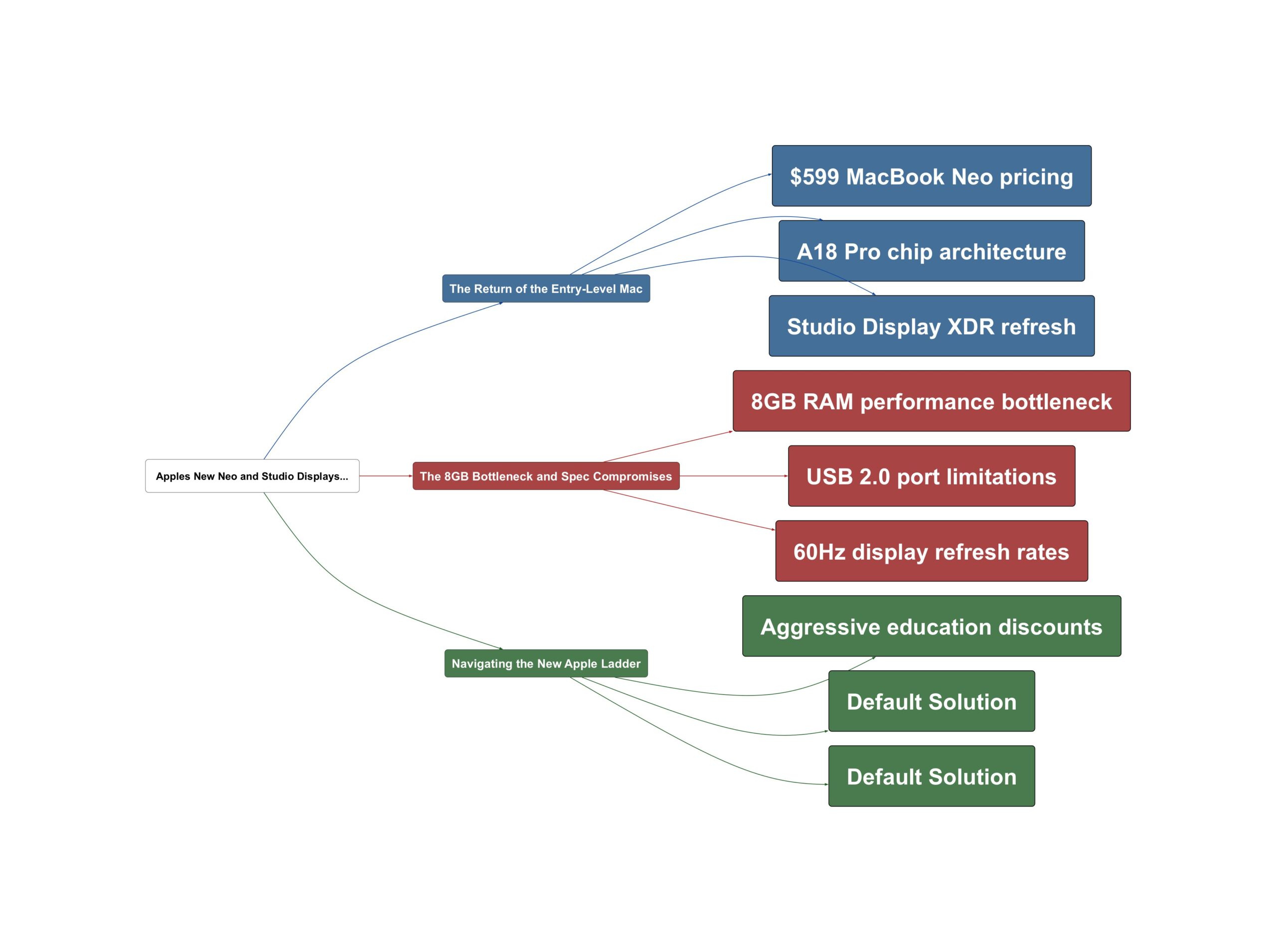
The situation centers on the MacBook Neo, a $599 machine ($499 for education) that feels like a spiritual successor to the plastic MacBooks of old. Leveraging the A18 Pro chip—silicon typically reserved for iPhones—Apple is hitting a price point that makes the PC market nervous. As one commenter noted, ‘This is a major challenge to Microsoft. A 13-inch Surface Laptop costs $899, that’s 50% more than an equivalent MacBook!’ The move suggests a shift toward a unified architecture where mobile and desktop boundaries blur. The community has observed that the Neo isn’t just a budget toy; its single-core performance actually edges out the original M1 chip, making it a formidable contender for casual use and education.
This is clearly targeted towards education but I think I will happily replace my MacBook Air M1 with this 🙂
The 8GB Bottleneck and Spec Compromises
However, the complication arises when you look past the colorful chassis. The base model’s 8GB of RAM remains a point of intense friction in an era of memory-hungry browsers. ‘8GB. Fuck off no chance. Not in a world of everyone shipping fat browsers,’ argued one skeptical user, highlighting that even educational web apps now demand significant resources. Beyond memory, Apple has made curious cuts: one of the two USB-C ports is limited to USB 2.0 speeds, and there is no MagSafe or Thunderbolt support on the base Neo. The frustration extends to the display lineup, where the $1,600 Studio Display refresh still lacks a 120Hz ProMotion panel. Here’s the thing: while the Neo aims for the low end, the Studio Display XDR targets the high end at $3,300 but effectively ‘replaces’ the 6K Pro Display XDR with a 5K panel, leaving some pros feeling downgraded.
It’s mind-boggling that Apple is considering the base 27 inch Studio Display with the same 4 year old panel… as an upgrade.
Navigating the New Apple Ladder
The resolution lies in understanding Apple’s aggressive market segmentation. For students and office workers who primarily browse and fill forms, the Neo is a ‘perfectly performant, luxury-feeling laptop’ that will likely ‘eat Chromebooks for lunch.’ The A18 Pro chip proves that mobile silicon can handle a desktop OS, potentially paving the way for a more unified ecosystem. For those needing more, the ‘laddering’ strategy is clear: if you want Touch ID, more RAM, or high-refresh displays, you must pay the premium. In practice, though, the Neo provides a vital entry point for ‘mischief’ and experimentation for a new generation.
If we’re talking ‘child’s first laptop,’ this gives them a full-fat desktop OS with ample power to get into various mischief.
Ultimately, the community consensus is to buy for your current workflow rather than future promises, especially given the lack of repairability and locked-down specs.
💡 Key Takeaway: Apple’s new lineup prioritizes entry-level access over pro-grade specs, requiring careful workflow mapping.