Microsoft’s aggressive push for integrated AI, mandatory accounts, and persistent telemetry has reached a breaking point for many, sparking a renewed interest in the Linux desktop as a viable daily driver.
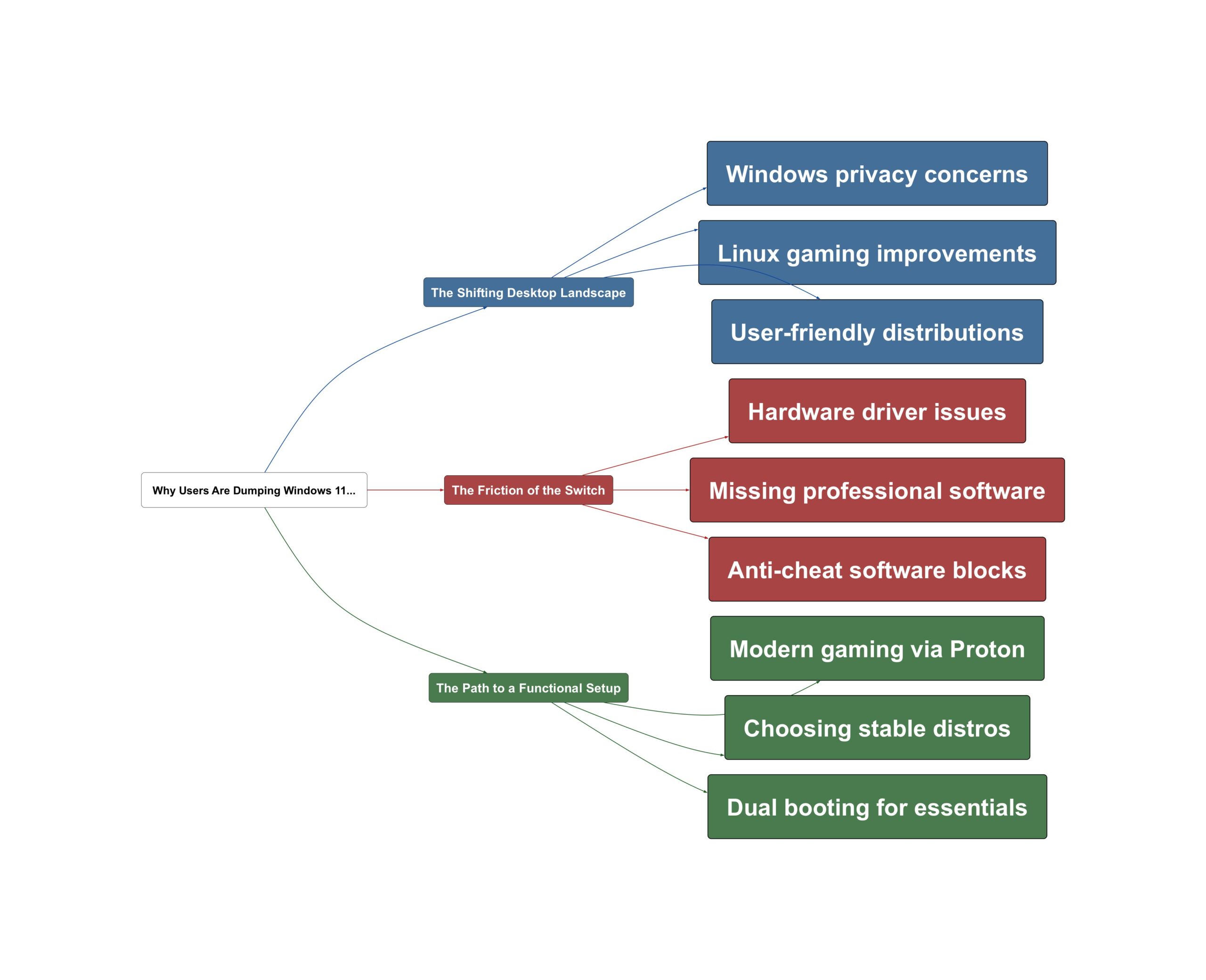
The Shifting Desktop Landscape
The current state of computing is seeing a significant shift as users prioritize privacy and performance over corporate ecosystems. Several key trends are driving this migration:
- A growing rejection of creepy business practices and negative design patterns in Windows 11.
- The massive improvement in Linux gaming compatibility, largely driven by the Steam Deck and Proton.
- The emergence of atomic and user-friendly distributions that offer macOS-like stability.
I don’t like windows due to their creepy business practices and negative design patterns in their OS… Forcing copilot is just the latest in their creepy practices.
As one commenter noted, the sentiment isn’t just about technical superiority, but about reclaiming control. Statistics from the community show that over 800 users upvoted the transition, signaling that the ‘Year of the Linux Desktop’ might finally be arriving for the privacy-conscious professional.
The Friction of the Switch
Despite the enthusiasm, the transition is rarely seamless. The Hacker News community highlighted several significant roadblocks that prevent a total migration:
- Persistent hardware issues, particularly regarding Wi-Fi drivers and power management on modern laptops.
- The lack of native support for professional creative suites like Adobe and various Digital Audio Workstations (DAWs).
- Complexities surrounding gaming anti-cheat systems and specific versions of popular titles.
I want to use Linux but I have to use Digital Audio Workstation. So in my case, I shouldn’t dump Windows (and thousand of $$ I’ve spent on audio software).
A highly-upvoted comment also pointed out that even ‘user-friendly’ distros can have sharp edges, noting that hardware support isn’t always perfect and niche professional software often requires complex workarounds that the average user may not be prepared to handle.
The Path to a Functional Setup
For those determined to make the switch, the community suggests a pragmatic approach rather than an all-or-nothing leap. Success often depends on choosing the right tools for the job:
- Opting for stable, well-supported distributions like Linux Mint, Fedora, or Zorin OS.
- Utilizing tools like Proton for gaming and Distrobox for development environments.
- Accepting a dual-boot configuration for essential, non-negotiable software like Tax apps or Office.
I switched to Bluefin… it is the best thing to ever happen to Linux. I get all the ease of use of something like macOS but pre-built with tools for development.
The community reaction suggests that while the transition requires effort, the reward is a stable and performant OS free from ads. As one long-time user summarized, the goal is to find an environment where the ‘agenda’ of the OS aligns with the productivity of the user.
- I dumped Windows 11 for Linux, and you should too
- I replaced Windows with Linux and everything’s going great