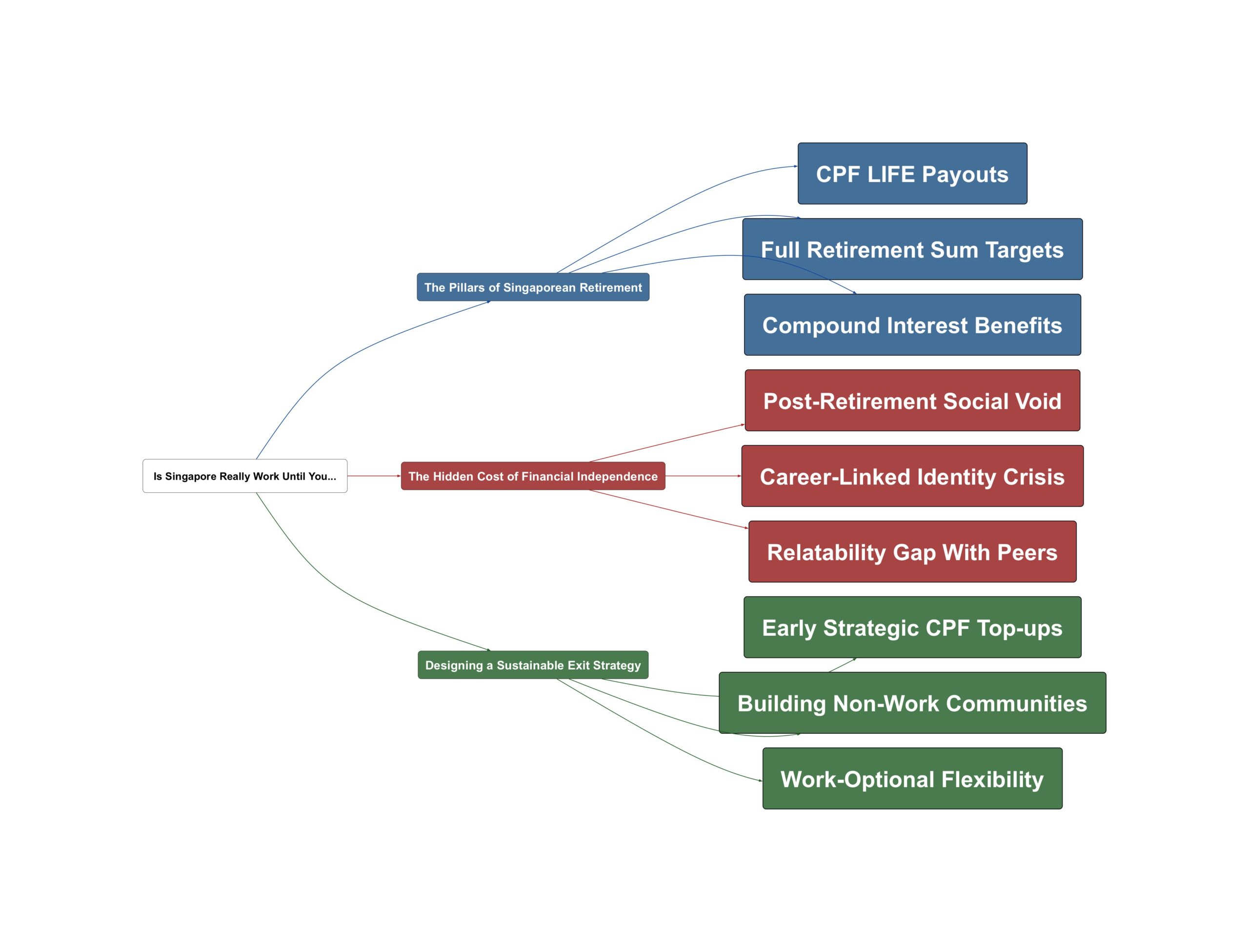
We have all seen those viral Reddit threads claiming that Singapore is a place where you work until your final breath just to survive the rising cost of living. But is this bleak outlook the full story, or are we missing the tools and psychological shifts needed to actually enjoy our later years? By looking at the mechanics of our retirement system and the often-ignored emotional toll of leaving the workforce, we can build a much clearer picture of what it takes to truly retire in the Lion City.
The Pillars of Singaporean Retirement
Despite the pessimistic headlines, the structural foundation for retirement in Singapore is actually quite robust if you know how to navigate it. The Central Provident Fund (CPF) remains the primary engine for long-term security. Many view it as a burden, but it functions as a disciplined savings mechanism that ensures a stable monthly income for life. As Kelvin Learns Investing explains, CPF is one of the best policies because it is specifically designed to provide for basic living expenses through CPF LIFE once you hit age 65.
Building on this, reaching the Full Retirement Sum (FRS) is more achievable than many realize. You do not need a CEO’s salary to hit your targets. Consider these points:
- Even with a salary of $4,000, which is below the median for fresh graduates, reaching the FRS by age 55 is feasible with modest increments.
- Strategic early interventions, such as making small top-ups at the start of your career, can leverage compound interest to do the heavy lifting for you.
I would argue that this is largely untrue, and the main reason for that is CPF. Personally, I believe that CPF is one of the best policies ever introduced by the Singapore government.
— Kelvin Learns Investing
The Hidden Cost of Financial Independence
But what happens when the money side is solved? This is where the complication arises. Financial independence often leads to a “social void” that many don’t anticipate. When you exit the 9-to-5 grind, you lose what experts call the “false community” of the office. Suddenly, while your friends are stuck in meetings, you are at home alone with your spreadsheets. This creates a Relatability Gap where your freedom can unintentionally feel like bragging to those still in the trenches. Sound familiar?
Beyond the social isolation, there is a deeper identity crisis at play. In a society that highly values status, many people tie their entire self-worth to their job titles. As HoneyMoney SG points out, losing the title of “Director” or “Manager” can lead to a vacuum of purpose.
There is this thing called the social void where, if you no longer have to be in the office, you lose something called the false community.
— HoneyMoney SG
Designing a Sustainable Exit Strategy
The resolution to the “work until you die” fear isn’t just about hoarding more cash; it’s about a dual-track approach of financial optimization and social engineering. First, treat your CPF as a strategic asset. By making even modest top-ups of $8,000 a year for just a few years early in your career, you can hit your FRS targets without further stress. According to Kelvin Learns Investing, this simple act can secure your basic needs regardless of future market volatility.
Secondly, you must proactively fill the social vacuum before you retire. This means:
- Joining interest-based communities, like the 23,000-member Telegram group managed by HoneyMoney SG, to find like-minded peers.
- Developing an identity that exists outside of your corporate business card.
- Embracing “work-optional” projects that provide interaction without the stress of a full-time role.
Community is your most important aspect once you reach your goals.
— HoneyMoney SG
The bigger picture? Retirement in Singapore is not a death sentence of endless labor, provided you leverage the system’s strengths and prepare for the psychological shift of leaving the workforce.
💡 Key Takeaway: Retirement success requires balancing CPF financial targets with a strong non-work social identity.
Video Sources